Lady Be Good: The WWII Bomber That Overshot Home by 400 Miles
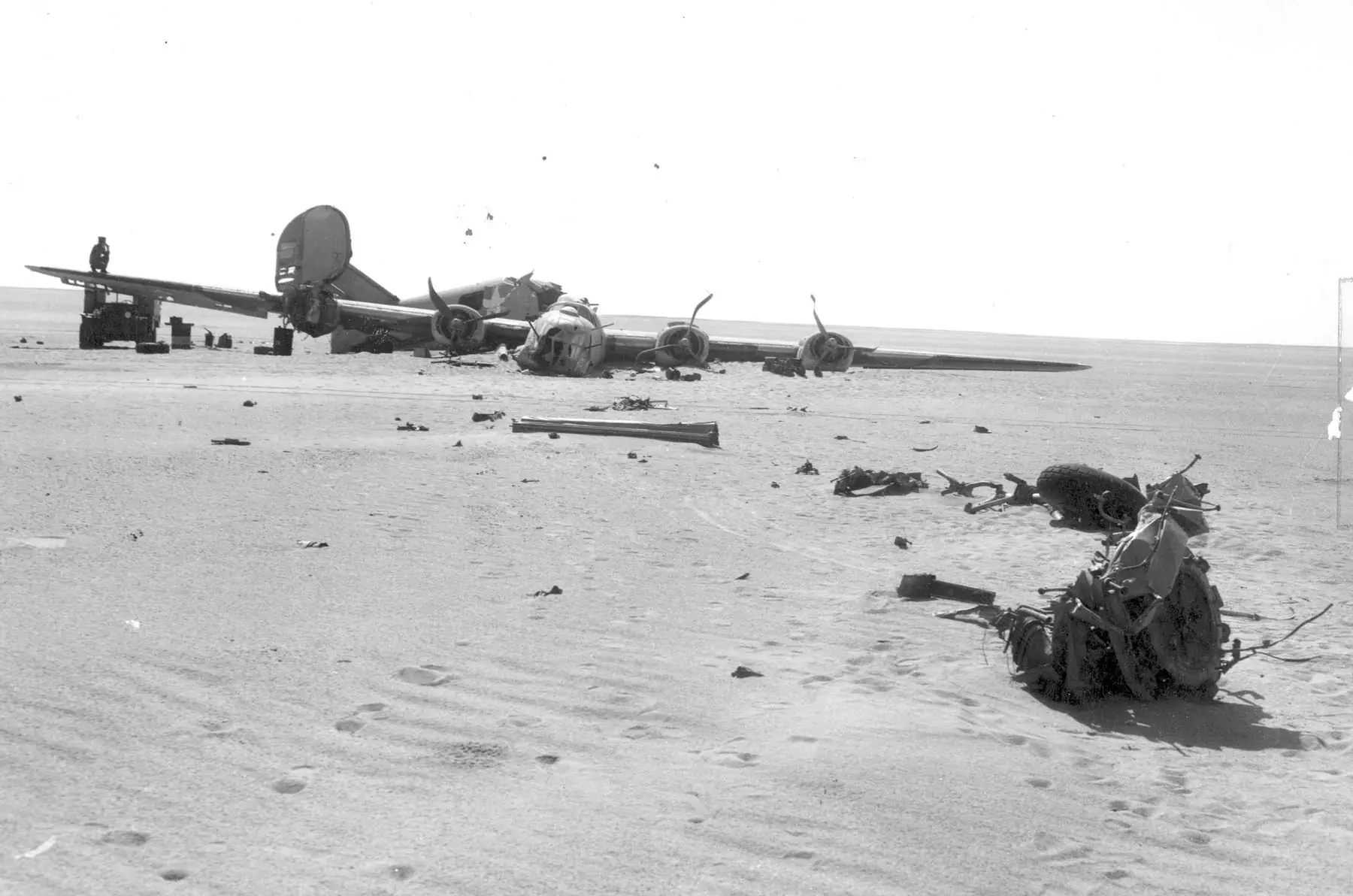
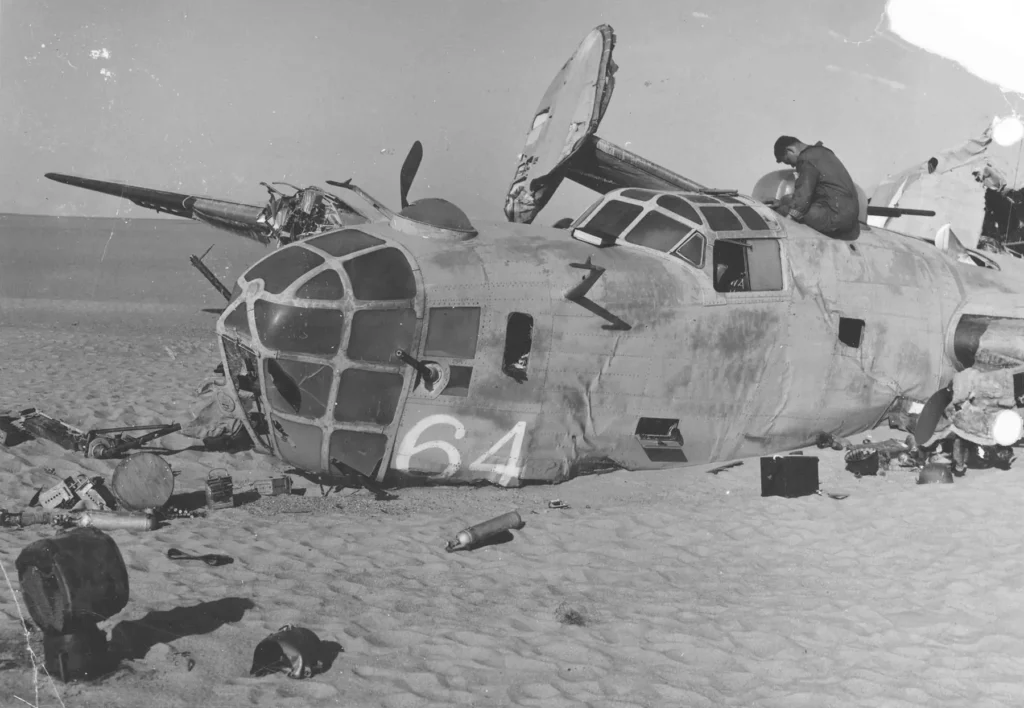
The bomber lay on a gravel plain in the Libyan Desert, its back broken behind the wings. When American investigators reached the Lady Be Good in 1959, one of its .50-caliber machine guns still fired at the pull of a trigger. A radio taken from the wreck replaced a dead set in a recovery plane and worked perfectly.
What the searchers could not find was the crew. The B-24D had vanished on its first combat mission in April 1943 and was presumed lost at sea. Yet here it sat, about 400 miles south of its base, with no bodies aboard and no parachutes.
Over the next year, boots, parachutes and two pocket diaries would reveal what happened after a crew flew past its own airfield and kept going into the Sahara.
Table of Contents
A Green Crew’s First and Last Mission
On the afternoon of April 4, 1943, 25 B-24Ds of the 376th Bomb Group took off from Soluch, an airstrip near Benghazi, Libya, to bomb the harbor at Naples, Italy. For the nine men aboard Lady Be Good, it was their first combat mission.
The crew: pilot William Hatton, copilot Robert Toner, navigator D.P. Hays, bombardier John Woravka, engineer Harold Ripslinger, radio operator Robert LaMotte, and gunners Guy Shelley, Vernon Moore and Samuel Adams.
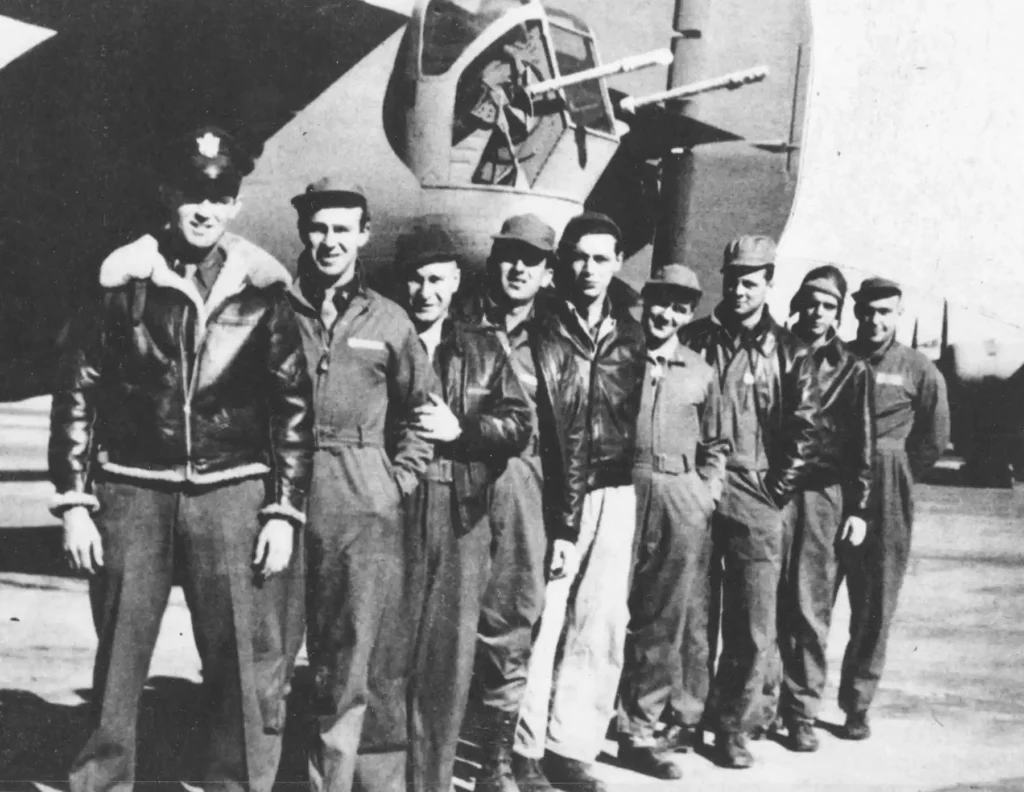
The raid went badly. Sandstorms forced many bombers to turn back. Toner summed it up in his pocket diary: “Naples, 28 planes, things pretty well mixed up.” Accounts disagree on whether Lady Be Good reached the target, but it headed home alone, at night.
How Do You Fly Past a Whole Coastline?
The bomber flew home above the clouds, with no view of the ground. Around midnight, Hatton radioed that his automatic direction finder, meant to home in on base, was not working properly.
The Army’s Graves Registration report, quoted by the U.S. Army Quartermaster Foundation, says the bomber was on a 150-degree course toward Benina airfield near Benghazi. It asked Benina’s direction-finding station for a bearing and got 330 degrees, a reading that fit a plane still out over the sea and on course for home.
Investigators concluded that the navigator “probably took a reciprocal reading” from a position already “beyond and south of Benina.” A loop antenna can’t tell a signal ahead from one behind, so a bearing taken past a station can look like one taken on the way in. Holding course, the crew flew deeper into Libya for about two more hours.
That is the investigators’ inference. The foundation also cites strong tailwinds. Author Mario Martinez argues that a radio operator at Benghazi never answered the bomber’s call, reportedly suspecting a German plane. A veteran he quotes, William McCain, wrote in 1985 that back at base they heard a plane passing nearby and “fired flares to attract its attention.”
Around 2 a.m., with fuel nearly gone, the crew jumped. Toner’s entry ends: “landed in desert at 2:00 in morning, no one badly hurt, can’t find John, all others present.” John was Woravka, the bombardier.
The empty bomber flew on another 12 to 16 miles, by different estimates, then belly-landed and skidded nearly 700 yards. Only one of its four engines was still running.
Found From the Air, 15 Years Later
In 1958, survey flights for D’Arcy Oil, later part of British Petroleum, spotted a bomber on the sand. The Air Force museum dates the sighting to Nov. 9; other accounts say May. Wheelus Air Base, near Tripoli, had no record of a plane lost in that area.
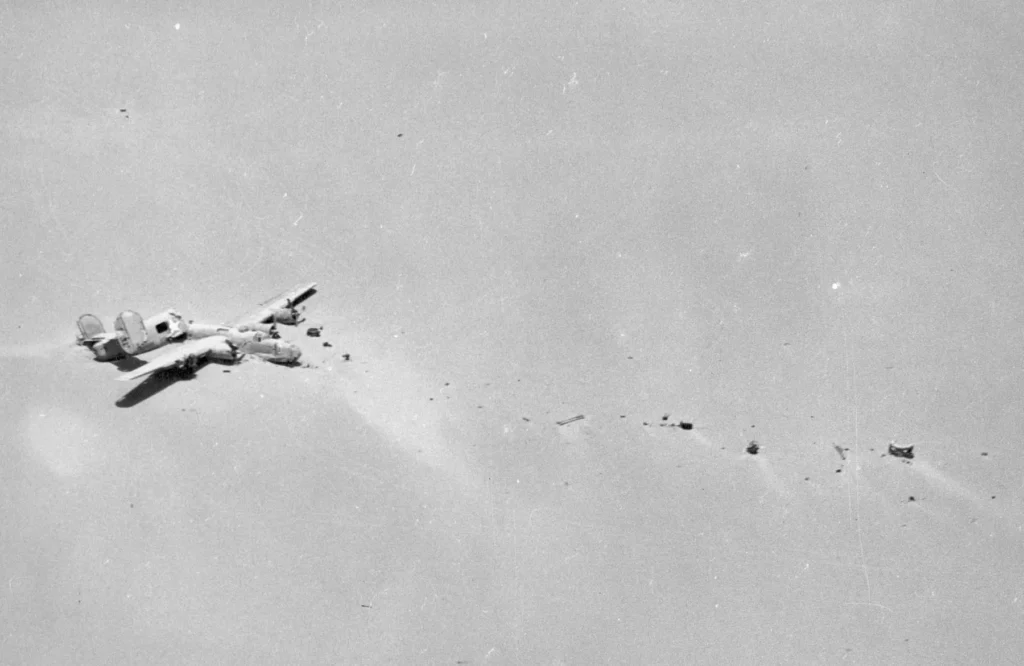
A D’Arcy ground party reached it in early 1959. Surveyor Gordon Bowerman sent the Wheelus commander the plane’s maintenance details and crew names found on its gear, and the Army’s mortuary service in Germany was called in.
The find made headlines, and “The Twilight Zone” drew on it for a 1960 episode, “King Nine Will Not Return.” The details grew in the telling. The Atlanta Constitution reported that a 1959 follow-up expedition found drinkable water and “coffee that still had coffee flavor,” as Smithsonian’s Air & Space magazine later noted. Retellings, including a 2014 Air Force Magazine feature, made it a thermos of still-drinkable coffee; others say tea. The Quartermaster Foundation’s account confirms the gun and radio but not the coffee.
The searchers did find a trail. Nineteen miles north of the wreck lay a pair of flight boots, toes pointing north. Farther on, along old wartime vehicle tracks, were parachutes cut and weighted with stones into arrowheads. One harness had “V. L. Moore” stenciled inside. Then the trail vanished into the dunes of the Calanscio Sand Sea, and the 1959 search was abandoned.
Eight Days in Toner’s Diary
In February 1960, a British Petroleum crew found the remains of five men on a plateau inside the sand sea: Hatton, Toner, Hays, LaMotte and Adams. Toner’s diary was in his pocket.
They had walked northwest, toward the coast, with “1/2 canteen of water, 1 cap full per day,” Toner wrote on the first day. They rested through the heat and walked at night. By Thursday they had hit the dunes, and sun and blowing sand were ruining their eyes.
On Friday, April 9, he wrote: “Shelley, Rip, Moore separate & try to go for help.” The other five stayed put. Sunday brought “Still waiting for help, still praying” and the line that they “could make it if we had water.” Monday’s entry was the last: “No help yet, very cold nite.”
Desert survival experts had predicted the airmen could walk only 25 or 30 miles. The five made it about 80 miles (78 by the Air Force museum’s count, 85 by the Army Quartermaster account) on half a canteen of water shared among eight men. They lived eight days, the museum notes, where two were expected.
That spring, an Army-Air Force search called Operation Climax brought in helicopters. A BP work party found Shelley on May 12; five days later, a helicopter crew spotted Ripslinger on a high dune. Accounts disagree on the distances, but the museum credits one of the three with 109 miles. Ripslinger had kept a diary, too.
In August 1960, another BP team found Woravka about 12 miles north-northeast of the wreck, still harnessed to a parachute that had not opened properly. According to Air Force Magazine, his canteen held almost a quart of water.
The Man the Sahara Kept
Vernon Moore was never found, though the searches covered some 6,300 square miles. Martinez has suggested that a skeleton a British army convoy found and buried in the sand sea in 1953, five years before anyone knew the bomber was there, might have been Moore’s. It has never been confirmed, which leaves his fate among the mysteries that still have no answer.
Did the Lady Be Good Curse Other Planes?
The most durable legend concerns salvaged parts. The Air Force museum’s own fact sheet says parts installed in other aircraft “then experienced unexpected difficulties”: a C-54 had propeller trouble and dumped cargo, a C-47 ditched in the Mediterranean, and a U.S. Army Otter crashed in the Gulf of Sidra with 10 men aboard. One of the few pieces that washed ashore, it says, was a Lady Be Good armrest.
The Otter crash is real: an Army U-1A vanished over the gulf on Jan. 4, 1960, with a pilot and nine passengers. According to the DHC-3 Otter Archive, the pilot cut across open water against standing orders and apparently flew into a squall line. Giffen Marr, a pilot who joined the search, recalled seeing the armrest lying on the beach. His unit’s maintenance officer had taken it from the bomber as a model for the Otters’ armrests.
A shortcut over open sea explains that loss better than a curse, and the other two incidents are harder to pin down. When Roger Connor of the Smithsonian’s National Air and Space Museum covered the rumor in a 2017 talk, Air & Space magazine’s summary was blunt: “a nice story, but not true.”
What Remains of the Lady Be Good Today
In 1968, a Royal Air Force desert rescue team hauled out 21 items, including an engine, for McDonnell Douglas to study, partly to see how long-term storage might affect ballistic missiles. An Army-issue Elgin wristwatch recovered with the crew, tested that year, still kept time to within 10 seconds a day. Souvenir hunters stripped the rest, and in 1994 Libyan authorities moved what was left to a military base at Tobruk.
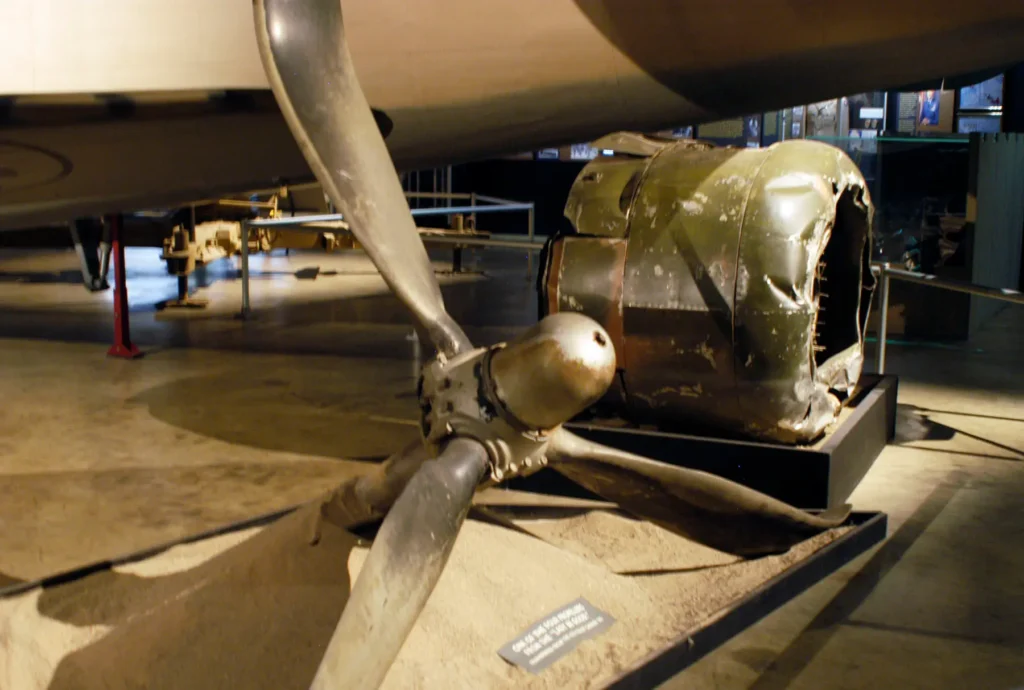
The National Museum of the U.S. Air Force in Dayton, Ohio, has displayed one of the bomber’s engines and propellers, its nosewheel and items from the crash site. The Smithsonian’s collection includes three of its flight instruments, and the Army Quartermaster Museum in Virginia received crew watches and a survival map. Another propeller stands outside the village hall in Lake Linden, Michigan, radio operator Robert LaMotte’s hometown.
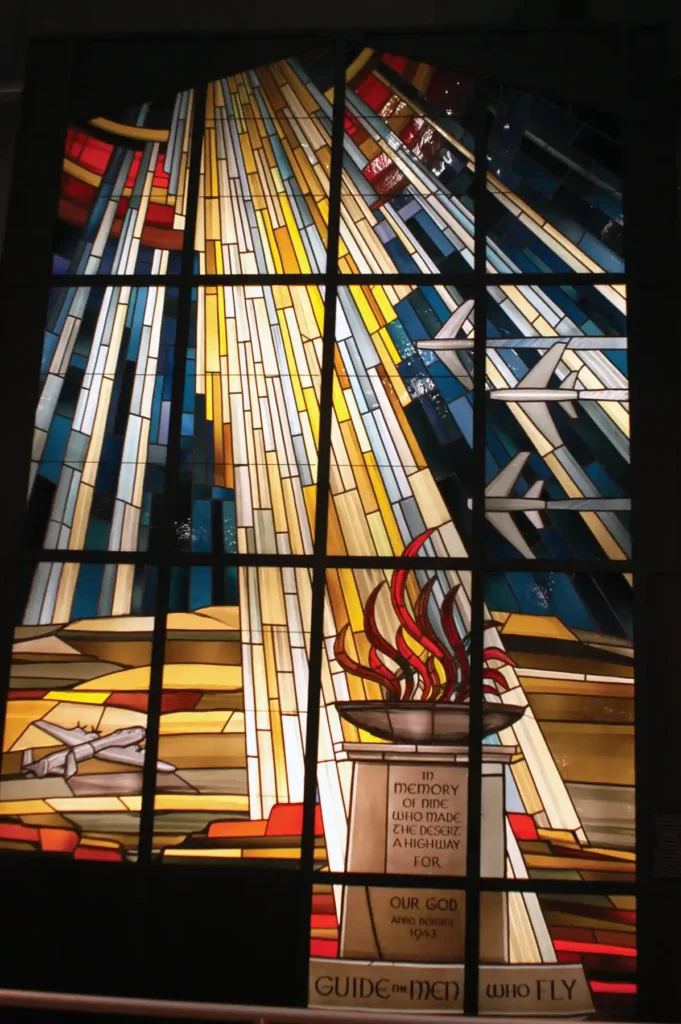
The most striking memorial is a stained-glass window. Airmen at Wheelus paid for it, German artist Peter Hess designed it, and it was unveiled in the base chapel in January 1961. After Wheelus closed in 1971, it went to the Air Force museum. Its inscription, echoing the Book of Isaiah, honors nine “who made the desert a highway for our God.”
By the end of 1960, 17 years after they jumped into the dark, eight of the nine had been found. Vernon Moore is still out there.
Sources
- “Lady Be Good” fact sheet
- Lost and Found: The Story of “Lady Be Good” and Her Crew
- “Lady Be Good” B-24 Bomber, Graves Registration Search and Recovery
- Lady Be Good
- World War II’s Most Famous Ghost Plane
- Case Closed: The Lady That Didn’t Come Home
- Points of Focus
- Are These the Remains of Vernon Moore?
- Otter 235 (57-6115) history
- A fitting memorial: Propeller honors Lake Linden man
Parts lie strewn across the sand where the Lady Be Good skidded to a halt in the Libyan Desert. Image by U.S. Air Force, public domain.