The Night St. Francis Dam Failed and Changed California
On the morning of March 12, 1928, dam keeper Tony Harnischfeger noticed a troubling leak at the St. Francis Dam. He called in the men responsible for Los Angeles’s water system. They inspected the site and left without ordering an evacuation.
Before midnight, the dam was gone.
The St. Francis Dam disaster released more than 12 billion gallons of water into a valley of homes, work camps, and citrus groves. More than 400 people died. A structure built to protect a growing city’s water supply had become a threat to the people living below it.
The most unsettling question would outlast the flood: How had a project so important depended on so little independent scrutiny?
Table of Contents
A reservoir for a thirsty city
Los Angeles had grown around an awkward promise. A city could expand in a dry landscape if engineers could keep bringing it enough water.
William Mulholland had made that promise seem credible. An Irish immigrant who began his Los Angeles career tending water ditches, he educated himself and rose to lead the municipal water system. In 1913, the Los Angeles Aqueduct began carrying water south from the Owens Valley. It was an extraordinary achievement, and Mulholland became its human symbol.
Yet an aqueduct did not eliminate the need for storage. Drought, rising demand, and the possibility of an interruption in the long supply line made a reserve close to the city valuable. The St. Francis reservoir, in San Francisquito Canyon north of Los Angeles, was supposed to provide that cushion.
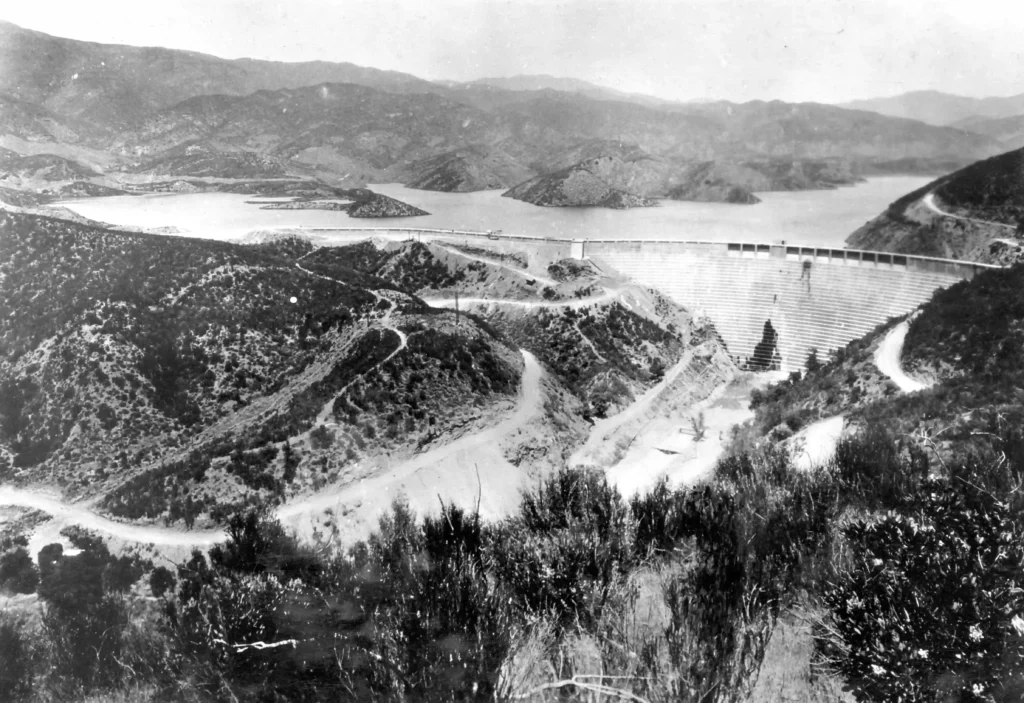
Construction began in 1924 and was completed in 1926. Within two years, the reservoir was approaching the condition that would test the structure most severely: being full.
The warning that did not become an alarm
On March 7, 1928, the water reached nearly to the spillway crest. Five days later, Harnischfeger’s concern brought Mulholland and his assistant, Harvey Van Norman, to the dam.
Leakage alone does not establish that a dam is about to fail. Engineers must distinguish expected seepage from water that is eroding material, finding a dangerous route, or revealing movement. That distinction gives an inspection its stakes: someone must decide what the evidence means before the outcome is known.
The March 12 inspection did not produce a warning to the communities downstream. Mulholland and Van Norman considered the observed conditions insufficient to indicate imminent danger.
Harnischfeger remained near the structure with his family. When the dam failed shortly before midnight, those closest to it had almost no opportunity to escape.
The interval between inspection and collapse is one reason the story remains so disturbing. An inspection had occurred. The people with authority had seen the site. Their reassurance could not make the foundation safe.
What the St. Francis Dam disaster exposed
From a distance, a concrete dam looks like a wall. In engineering terms, it is also a relationship between the wall, the ground beneath it, and the hillsides supporting its ends.
St. Francis was a curved concrete gravity dam. Its weight helped resist the reservoir’s push, but that resistance depended on the behavior of the entire structure and its foundations. Water pressure beneath a dam can reduce its effective resistance to movement. Rock that appears reassuring at the surface can behave differently when loaded or saturated.
Later investigations identified a dangerous combination of structural and geological conditions. The dam had been raised during construction without a corresponding widening of its base. Its two abutments, the places where it met the canyon walls, rested in different rock formations.
In their 1993 reassessment, engineers J. David Rogers and David McMahon emphasized an ancient landslide in the eastern abutment, weaknesses in the dam’s stability, and the interaction of water pressure with the surrounding rock. Their reconstruction challenged important parts of earlier explanations.
The distinction matters. The collapse was not a simple demonstration that concrete was weak or that one visible crack caused everything. It was a failure of a structure working with ground whose behavior had not been adequately understood.
A flood moving toward sleeping towns
The released reservoir struck power facilities and settlements in San Francisquito Canyon, then moved into the Santa Clara River Valley toward the Pacific. Bridges, roads, homes, and farmland lay in its path.
For people farther downstream, survival could depend on a message arriving minutes before the water. In Santa Paula, telephone operator Louise Gipe helped relay the alarm. Police officers Thornton Edwards and Stanley Baker rode motorcycles through threatened neighborhoods to warn residents to leave.
There was no single warning that reached everyone at once. Information passed through people, telephones, vehicles, and shouted instructions. Some residents had time to climb. Others were overtaken while trying to gather relatives or possessions.
A monument in Santa Paula later honored the motorcycle warnings. Its subject captures a different kind of infrastructure: a chain of people trying to communicate danger after the physical barrier had already failed.
The reservoir’s location upstream had linked these communities to Los Angeles’s water system whether they benefited from it or not. During the night, that connection became impossible to escape.
The people behind the death toll
Ten-year-old Soledad Luna lived among the citrus workers near Santa Paula. When water tore apart her family’s home, she and her mother and siblings were swept away on a mattress. Soledad became caught in a tree and survived until morning.
Her mother and siblings survived too. Five cousins did not. PBS’s account, drawing on the family’s history, restores names and relationships to a disaster often told through photographs of broken concrete.
Even the total number of deaths resists a single neat figure. Official and historical sources report differing counts, including 420, more than 432, and more than 450. Missing people, incomplete records, and the circumstances of migrant communities complicated the accounting. More than 400 deaths is a defensible description; an exact total would suggest certainty the sources do not share.
UCLA Library also highlights how racial discrimination affected relief and compensation. Surviving the flood did not guarantee equal treatment afterward. The disaster continued through the struggle to recover homes, livelihoods, and recognition.
A famous engineer was not a safety system
Mulholland accepted responsibility before the coroner’s inquiry. His standing in Los Angeles could not survive the catastrophe, and he retired later in 1928.
Debate over his responsibility did survive. Some later interpretations stressed geological conditions that were difficult to recognize with the knowledge available at the time. Historians Donald C. Jackson and Norris Hundley Jr. challenged the suggestion that these discoveries exonerated him. They examined contemporary engineering practice and argued that relevant safeguards were already available.
Those positions should not be collapsed into a claim that the cause has always been obvious. Reconstructing a destroyed dam is difficult, and the order in which sections failed remains a matter of analysis.
But a separate institutional problem is clearer. California’s existing dam-safety framework exempted municipal projects from state supervision. Mulholland could exercise extraordinary control without the independent review such a consequential structure needed.
The coroner’s jury rejected the idea that any engineer’s eminence should substitute for additional judgment. The point extended beyond one man’s character: a system that relies on personal authority has little protection when that authority is wrong.
The change that outlasted the ruins
In 1929, California created a stronger dam-safety program. The state gained responsibilities covering the examination of existing dams, review of plans, construction supervision, and oversight of maintenance for dams within its jurisdiction.
The reform changed who could ask questions and when. Safety could be examined before a reservoir filled, rather than reconstructed from fragments afterward. Approval and inspection became matters for an institution with continuing responsibilities.
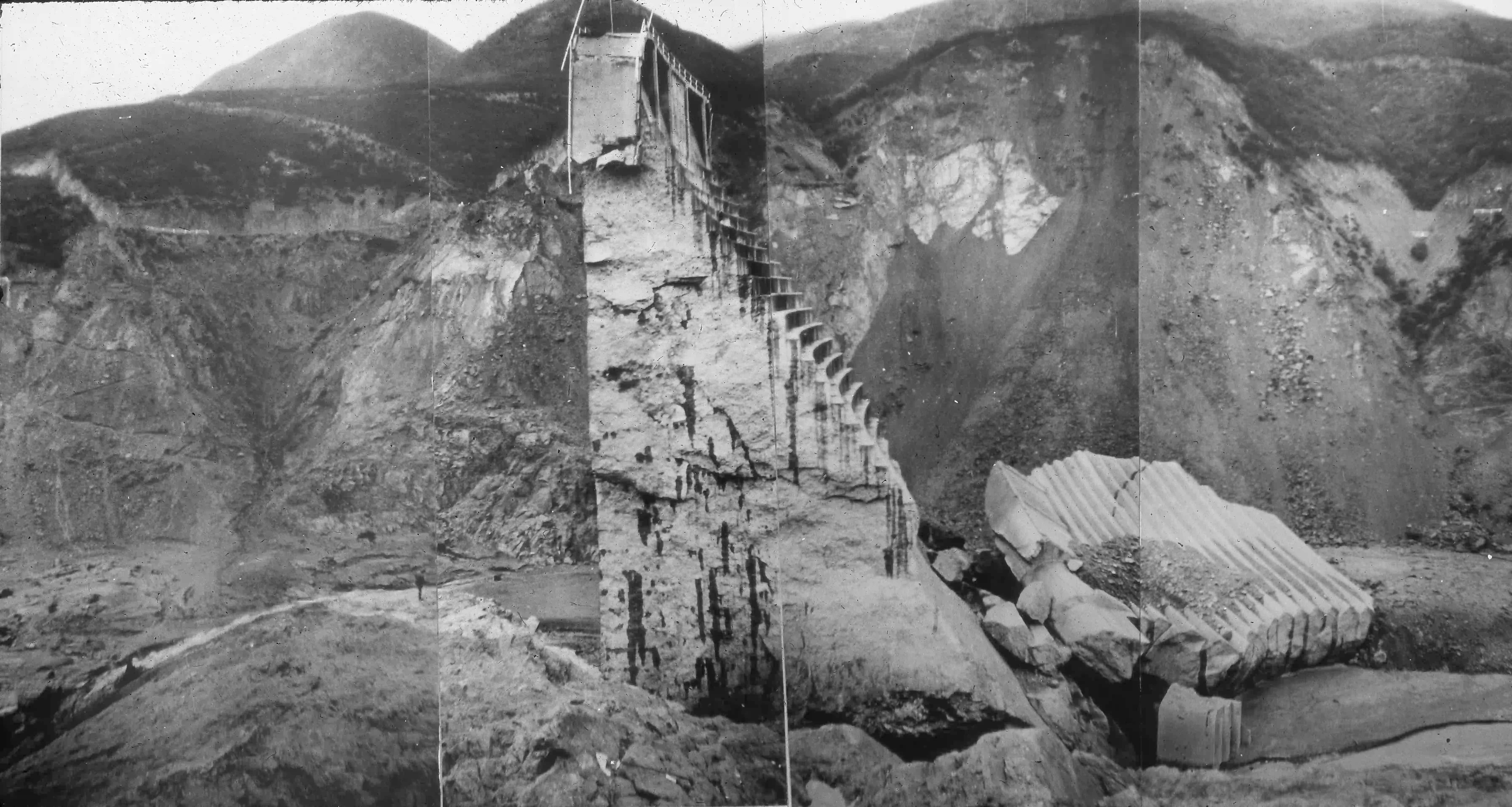
The surviving central section of St. Francis was demolished in 1929. Its disappearance could remove a physical hazard, but it could not resolve the losses downstream. Nor could it make the history fit comfortably into a story about one fallen hero.
Like the communities transformed by the Centralia underground fire, the Santa Clara Valley carries a history that is not fully visible in an ordinary landscape.
St. Francis’s lasting lesson lies in the gap between reputation and verification. Los Angeles had trusted the engineer who helped secure its future. After the flood, California built a system intended to make trust answerable to someone else’s inspection.
Sources
- California dam-safety history
- ASDSO case study
- Rogers and McMahon reassessment
- Jackson and Hundley on responsibility
- Soledad Luna’s story
- UCLA Library on the disaster
- Memorial foundation timeline
- Santa Paula’s warning monument
- HISTORY account of the collapse
Featured image: The central section of St. Francis Dam amid the wreckage in 1928. Photographer unknown, EBMUD archives. Public domain.