Dice, Game Tiles and a ‘Divine Wind’: New Clues From Kublai Khan’s Doomed Fleet
Five dice, each about 1 centimeter (0.4 inch) on a side. Twenty-nine thin tiles, called koppai in Japanese, marked with what look like pairs of dice faces. Divers recovered them this fall from the mud off Takashima, a small island in southwestern Japan, inside a warship believed to have sunk in 1281 during the Mongol invasion of Japan, the campaign behind the legend of the kamikaze, or “divine wind.”
Matsuura city’s education board announced the finds on October 28: the first suspected gaming pieces from a seabed site that has already yielded about 4,000 artifacts. “The koppai cards, which are considered precursors to mahjong tiles, were likely used for recreation,” said Yoshifumi Ikeda, the Kokugakuin University archaeologist who led the work with the city, according to The Mainichi.
It’s a modest find. Still, it puts ordinary people back aboard a fleet remembered mostly through the legend of a typhoon sent by the gods.
Table of Contents
A Galley, a Game and a Mother Ship?
Divers exposed about 15 meters (49 feet) of the ship’s hull, stern included, under mud roughly 18 meters (59 feet) down. Ikeda estimates the whole vessel was about 30 meters long, close to 100 feet. That would make it larger than the two other invasion wrecks found off Takashima.
“Given its size, the third vessel may have been a mother ship equipped with living quarters,” Ikeda said. “The discoveries offer a glimpse into life during wartime.”
Nearby lay what appears to be an iron kitchen knife, a ceramic pot that looks like a grinding bowl, and heaps of fish bones. Ikeda told the Nagasaki Shimbun that this part of the ship may have held a galley or food store, and that its crew may have passed the time with games.
Nobody knows when the games were played or who played them. It isn’t even clear which game it was. The tiles, about 1.2 by 0.6 inches and made of a material not yet identified, resemble pieces of a game that originated in China. Mongolian researchers at the announcement saw something else: pieces like those of daaluu, a game still familiar in Mongolia.
The Mongol Invasion of Japan, Round One
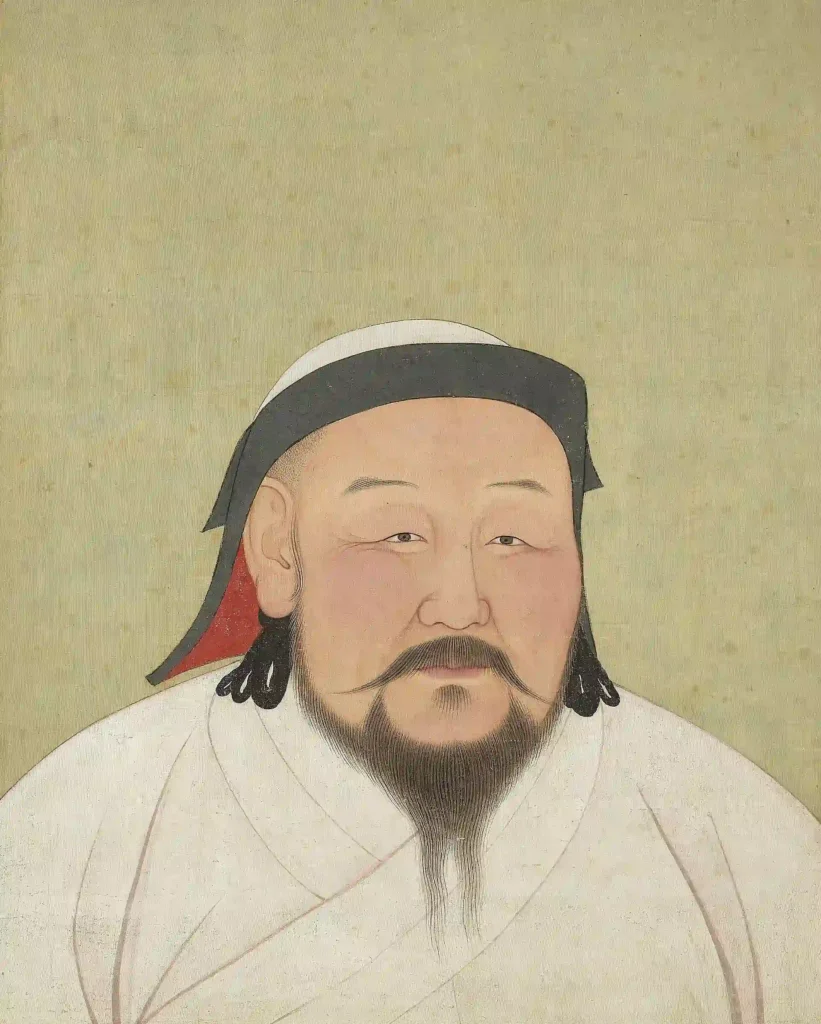
Kublai Khan, Genghis Khan’s grandson, founded China’s Yuan dynasty in 1271 and wanted Japan to submit. When his letters went unanswered, he sent some 900 ships from Korea in 1274, carrying roughly 30,000 soldiers and sailors. They landed at Hakata Bay, near today’s Fukuoka.
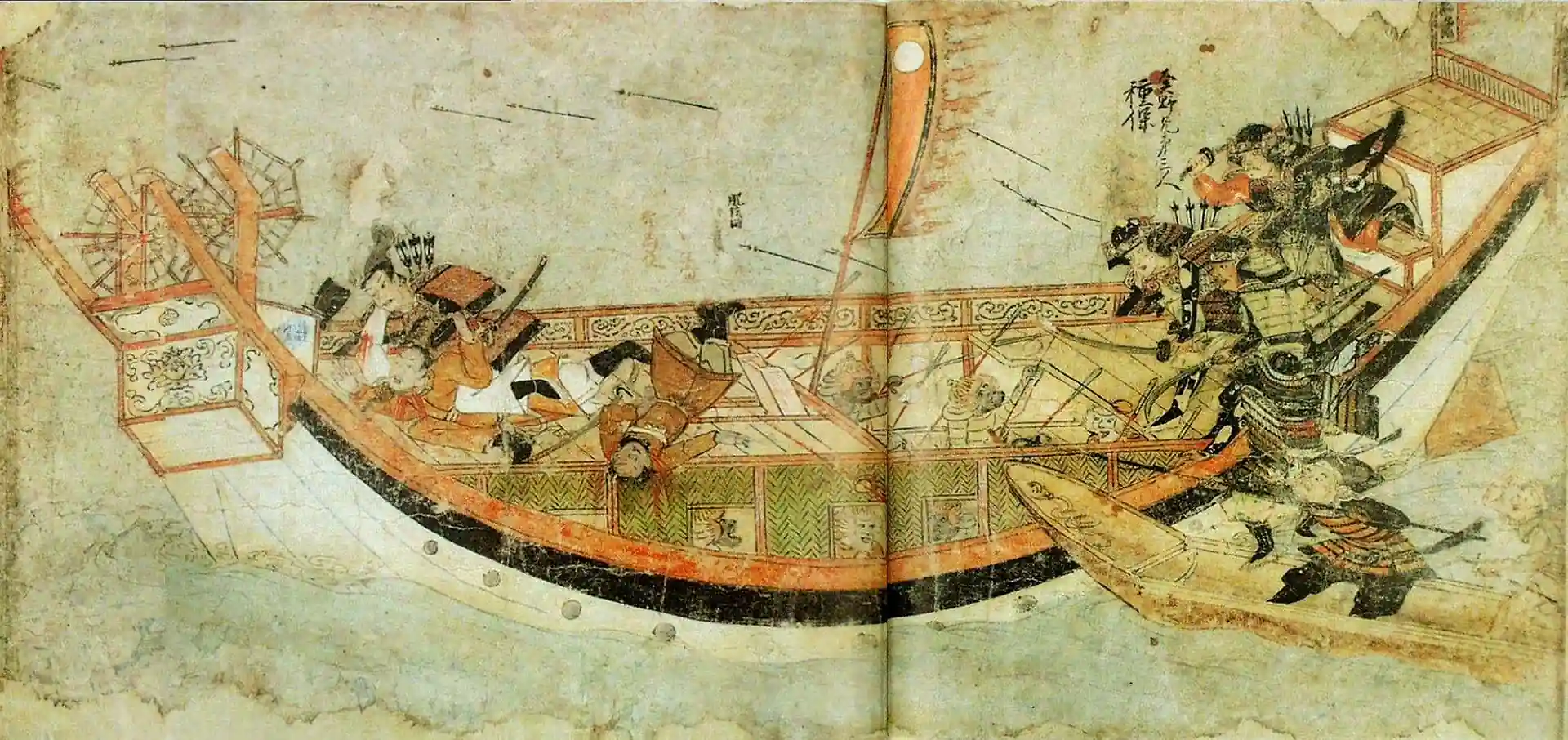
The samurai, who expected one-on-one combat, ran into an army that fought in tight groups, shot poisoned arrows and used shells that burst in midair with fire and smoke. Gunpowder was still unknown in Japan. In the best-known version, the invaders went back to their ships for the night, and by morning the fleet was gone.
Why they left is still debated. Modern Japanese textbooks variously blame infighting, low morale or samurai resistance. One historian calls the expedition a reconnaissance; another, Hideo Hattori, argues the army stayed about a week until a typhoon drove it off.
Japan did not wait to find out. The shogunate executed Kublai’s next envoys and built a stone wall about 12 miles (20 kilometers) long along Hakata Bay.
1281: An Armada Pinned Offshore
Kublai returned in 1281 with two fleets: one from Korea and a much larger one from southern China, drawing on the navy of the Song dynasty he had just conquered. Traditional accounts put the total at about 4,400 ships and 140,000 men. Princeton historian Thomas Conlan treats the 4,000-ship figure as speculation, and archaeologist Kenzo Hayashida, who dug at Takashima for years, thought hundreds of wrecks lie there, not thousands.
The fleets were supposed to meet at Iki Island, but the southern one set out about six weeks after the Korean fleet. Behind their wall, and raiding the anchored ships from small boats, the defenders kept the invaders from landing in force on Kyushu for roughly two months.
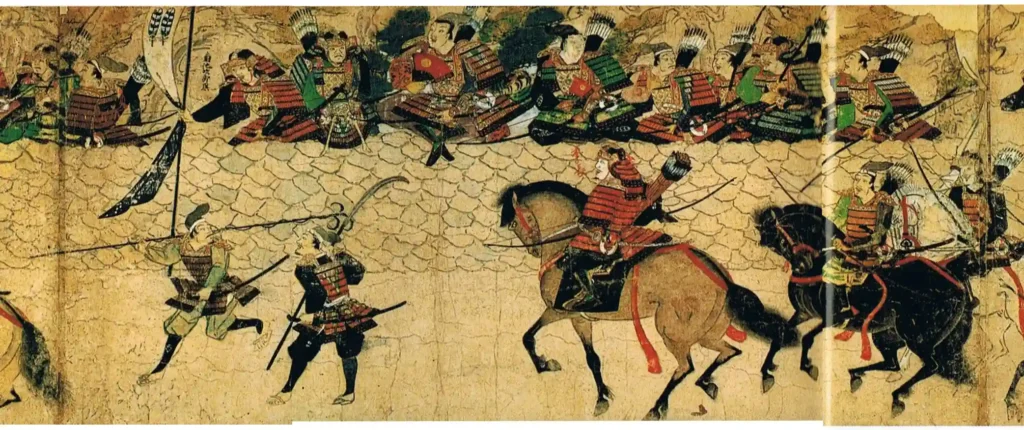
Then, in August 1281, a typhoon hit the crowded fleet near Takashima. Ikeda believes ships that lost their anchors were driven north “all packed together, knocking against and crashing into each other.” Commanders sailed home on vessels that could still float; the troops left behind, mostly unarmed, were no match for the shogunate’s soldiers.
How a Storm Became the Kamikaze
To the imperial court and the shogunate, the timing looked like an answer to prayer. In 1293 the court raised the status of a wind god’s shrine at Ise, and shrines and temples rushed to claim credit; one Buddhist priest said the winds began to blow as he prayed. Over time, the belief spread that a kamikaze would protect Japan in its hour of need.
The warriors saw it differently. “Having fought tooth and nail against the enemy, killing and being killed in droves,” Hattori told Nippon.com, “they had a very different perspective of the outcome.”
More than 650 years later, as Japan moved toward war, its authorities revived the legend. Elementary-school textbooks first included the kamikaze story in 1934; a 1943 textbook told children, in Nippon.com‘s translation, “As Japan is a divine land, the wind blew fiercely against the surging hordes of ships.” In 1944 and 1945, the name went to suicide pilots who flew their planes into Allied ships.
“The myth that Japan could never be defeated,” Hattori says, “drove the population to unquestionably support a reckless war.”
Storm, Shoddy Ships or Samurai?
So was it really the weather? In a 2015 study, University of Massachusetts Amherst geologist Jon Woodruff and colleagues found two layers of seaborne flood sediment in Lake Daija, a lagoon on Amakusa Island, dating to the era of the kamikaze typhoons. Their results, they wrote, support “the paired Kamikaze typhoons playing an important role in preventing the early conquest of Japan by Mongol fleets,” though radiocarbon dates can’t pin down exact years.
The seabed offers clues, too. Wooden anchors uncovered at Takashima in 1994 all pointed south; Ikeda suspects a typhoon dragged them north before they broke loose.
But the wrecks also describe a vulnerable fleet. Randall Sasaki, then a Texas A&M graduate student on Hayashida’s team, concluded that it was hastily assembled: some vessels were old or in poor repair, others first-rate Chinese warships. Conlan, reviewing Sasaki’s later book, described the lost ships as “a variety of craft, including river barges.” Archaeologist James Delgado, who dived on the site in 2002, reported crudely made storage jars and anchors weighted with two rough stones, quicker to make but weaker than one carved stone.
Then there are the defenders. In his book In Little Need of Divine Intervention, Conlan argued that the Japanese warriors ashore, plus the invaders’ own confusion and poor coordination, did more than the storms to stop Kublai. For 1281, at least, historians broadly agree that a typhoon dealt a catastrophic blow. The open question is how much help it had.
The Bomb in the Picture
One of the best-known images of the invasions shows Takezaki Suenaga, a samurai who fought in both campaigns and commissioned illustrated scrolls of his deeds around 1293, on a bleeding horse as a shell bursts overhead.
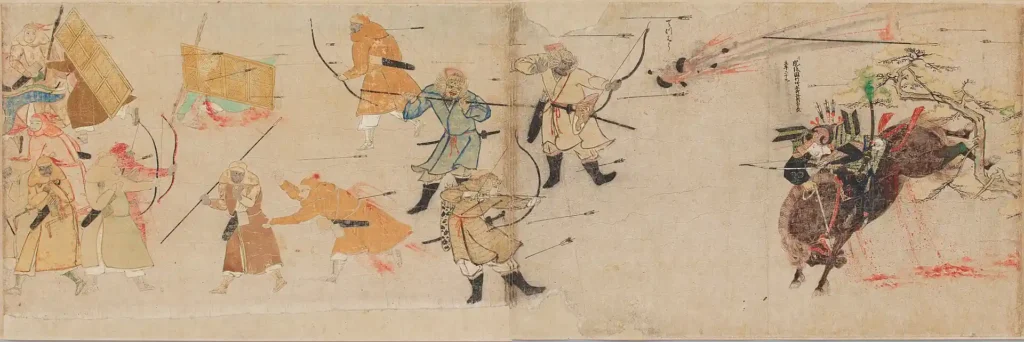
In a 2017 review, Conlan warned that the scroll “should be used with care,” because its image of an exploding projectile, complete with “hirsute, black-booted Mongols,” was added “over the course of the eighteenth century.”
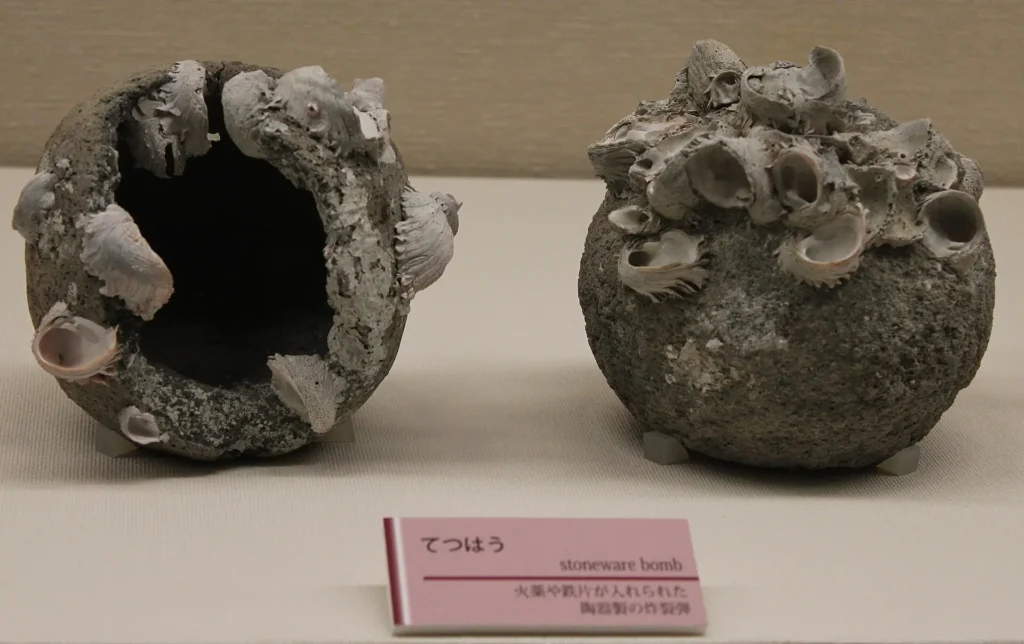
The weapon itself was real. Divers at Takashima have recovered ceramic bombs called tetsuhau. When Japanese researchers X-rayed two intact ones, Delgado reported, one contained nothing but gunpowder, while the other also held over a dozen square chunks of iron shrapnel.
What Takashima’s Mud Is Still Giving Up
Much like Lascaux’s painted cave, which a teenager found by accident, Kublai’s lost fleet first surfaced through chance finds. Fishermen had hauled up pots and weapons for generations, and a Mongol commander’s bronze seal turned up in a fisherman’s toolbox. The ships stayed hidden; exposed timber had long since been eaten by shipworms.
Ikeda spent years diving on sonar targets, striking the seafloor with an iron bar to tell shell from pottery from wood by sound. “We’d been plagued by doubts for six years, wondering if there really were ships at all,” he told Nippon.com. The first wreck was confirmed in 2011, and in 2012 part of the area became Japan’s first underwater site designated a national historic site. Buried in mud, Ikeda says, artifacts “become sealed as if in a time capsule.”
The finds keep changing the picture of who was aboard. Delgado reported that only 1 percent of the finds from Hayashida’s dig could be traced to Mongolia; the rest were Chinese. One bowl bears its owner’s name and rank: commander of 100. In April, researchers announced that a wooden board from the bottom of the third ship carries an inked Yuan-era date, 1275 or 1276, possibly part of a notice for the crew.
Specialists from Mongolia and South Korea took part in this year’s excavation, and more digging is planned for 2027. The Mongolian researchers now want to learn when, and how, daaluu reached their country.
For more than seven centuries, the Mongol invasion of Japan has been told as a contest between an empire and the gods. The dice tell a smaller story. If Ikeda is right, this warship had a galley where cooks and sailors far from home made meals and killed time with a game. Then the typhoon came.
Sources
- Dice, mahjong precursor cards found in 1281 Mongol invasion shipwreck
- Dice and koppai tiles found in Mongol invasion wreck (in Japanese)
- Third Mongol ship from 1281 attack confirmed off Nagasaki
- Ships on the Seabed: Searching for the Mongol Empire’s Lost Invasion Fleet
- Saved by the Wind? The Mongol Invasions of Japan
- Myth of the Kamikaze: The “Divine Winds” of the Mongol Invasion and Wartime Propaganda
- Relics of the Kamikaze
- Kublai Khan vs. Kamikaze
- Review of The Origins of the Lost Fleet of the Mongol Empire
- Depositional evidence for the Kamikaze typhoons
Japanese warriors storm an invaders’ ship in the Mōko Shūrai Ekotoba, illustrated scrolls made around 1293 (13th-century artwork). Image by unknown artist, public domain.