Two Galaxies Are Colliding. Why Aren’t Their Stars Crashing Together?
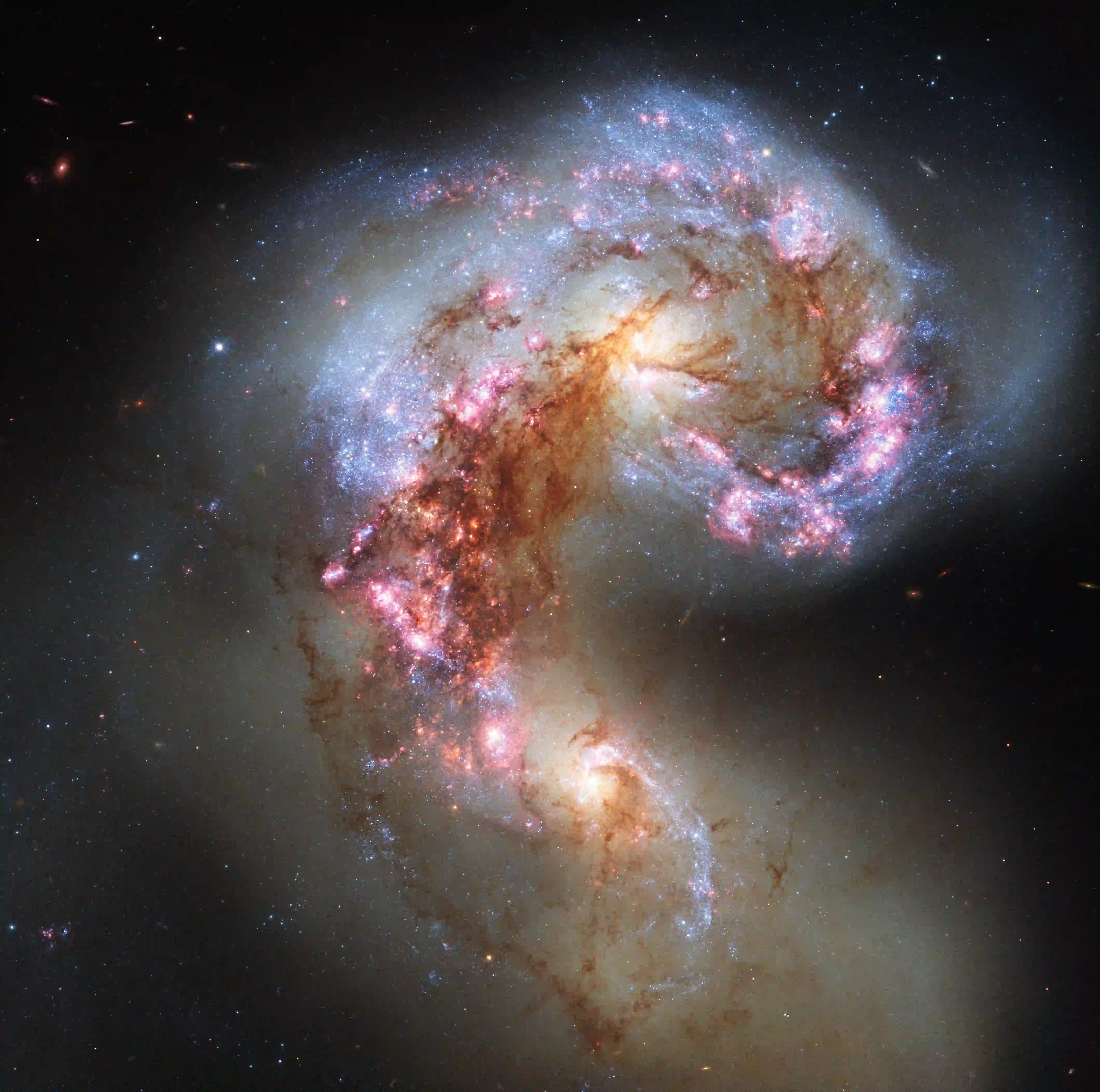
Two galaxies are pulling each other apart. In the Hubble image, dark dust cuts through glowing clouds, blue star clusters crowd the wreckage, and two bright galactic centers remain visible inside the tangle. The Antennae Galaxies look like the aftermath of an impossible traffic accident.
But the most surprising part is what usually misses: the stars.
Even as these enormous systems overlap, direct collisions between individual stars are extraordinarily unlikely. The galaxies can lose their familiar shapes without most of their suns ever striking another sun. To understand that apparent contradiction, look beyond the bright center of the picture.
Table of Contents
The Antennae Galaxies have already lost their shape
Cataloged as NGC 4038 and NGC 4039, the pair lies tens of millions of light-years away in the constellation Corvus. NASA places it roughly 62 million light-years from Earth. Published distance estimates differ, but the essential scene is clear: two once-separate spiral galaxies are undergoing a prolonged gravitational encounter.
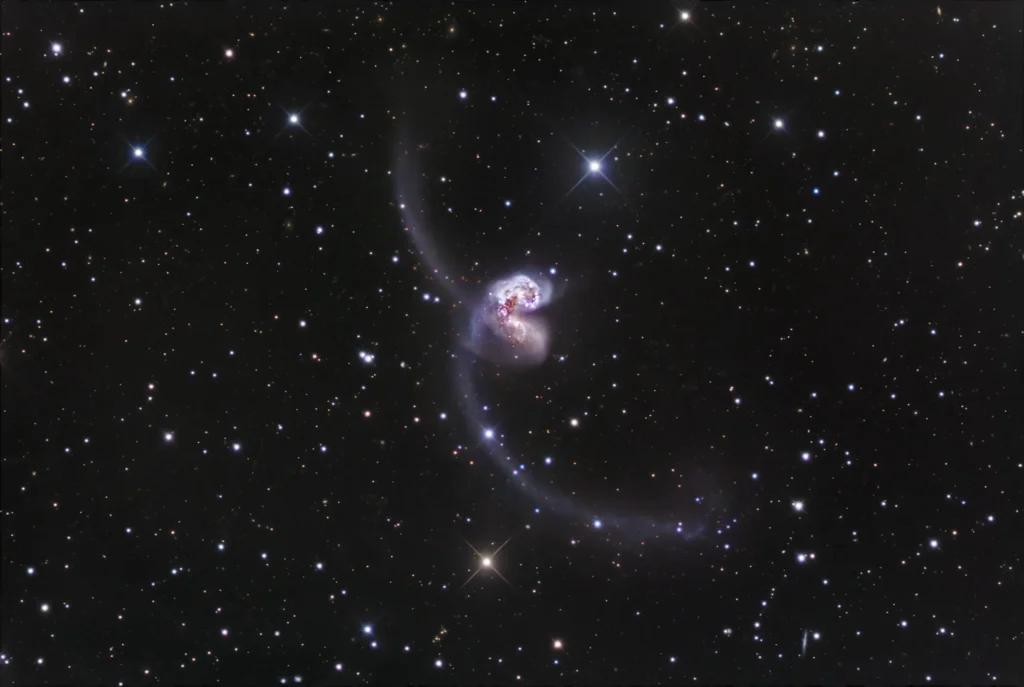
Their nickname makes more sense in a wider photograph. Two enormous streamers curve away from the central disturbance, resembling an insect’s antennae. Those tails contain material drawn outward as the galaxies interact. They are evidence that the encounter reaches far beyond the region where the galaxies appear to touch.
The close-up and the wide view tell different parts of the same story. One reveals crowded, brightly colored structure. The other shows how extensively the original galaxies have been stretched. A photograph that includes only the center leaves out some of the most revealing damage.
This has been unfolding over hundreds of millions of years. There was no single instant when two solid surfaces met. The galaxies approached, disturbed one another, and continued evolving under their combined gravity. What we see is one frame from an encounter far longer than human history.
A galaxy is mostly room to miss
A galaxy is not a solid object. Its visible stars are separated by distances enormously greater than the stars themselves. Add gas, dust, and a surrounding distribution of dark matter, and you have an extended system held together by gravity, not a rigid structure with an outer shell.
Consider a scale model. Shrink the Sun to a ball one inch across. Using the Sun’s diameter and the roughly 4.2-light-year distance to its nearest stellar neighbor, that neighbor would sit about 450 miles away. The model is only an illustration of our local neighborhood, not a claim that every galaxy has the same stellar spacing.
Now imagine two immense collections of such widely separated balls passing through each other. Overlapping the collections does not mean that their individual members will hit. Most paths have plenty of room between the targets.
That is why a galaxy collision and a star collision are different events. The word “collision” describes the encounter of the galactic systems. It does not imply that their stars behave like the tightly packed pieces of two crashing cars. NASA’s explanation of galaxy evolution makes this distinction explicit.
Gravity does not have to touch anything
Missing another star does not leave a star untouched by the encounter. Gravity acts across the gaps.
Before the interaction, a star follows an orbit shaped by its home galaxy’s mass. As another galaxy approaches, the gravitational surroundings change. Stars can be redirected into different orbits, and some are drawn into extended tails. The collective arrangement changes even when individual stars remain physically intact.
The Antennae’s streamers make that difference visible. They are not scratches left by stars scraping past one another. They trace the redistribution of material under gravitational forces. The galaxies’ outlines can be dismantled through changes in motion rather than a succession of direct impacts.
Astronomers investigate these transformations with computer simulations and compare the resulting shapes with real interacting galaxies. A simulation lets them watch a proposed encounter develop; an observation lets them test whether its structures resemble anything in the sky. Neither gives us a time-lapse camera recording of the entire Antennae encounter.
For anyone familiar with the Milky Way as a stable-looking band overhead, this is the unsettling part. A galaxy’s appearance can change dramatically without its stars needing to explode. Our guide to dark places where you can see the Milky Way shows the familiar view from inside our own system.
The gas does not slip through so easily
The galaxies contain more than scattered stars. Their interstellar gas behaves differently.
Extended gas clouds can interact, become compressed, and develop shocks. Where conditions allow dense regions to collapse under their own gravity, new stars can form. That gives the Antennae their central twist: an encounter that disrupts two existing galaxies also creates conditions for another generation of stars.
The blue concentrations and glowing pink regions in Hubble’s view are clues to that activity. The blue regions include young stars, while the pink emission traces glowing hydrogen associated with star formation. Dark lanes show where dust obscures the light behind it.
Hubble’s 1997 investigation revealed more than 1,000 bright young star clusters in the system. A cluster is a group of stars, so those bright features are not simply a thousand isolated suns. They represent concentrations of newly formed stars within the larger encounter.
The image is therefore doing two jobs at once. Its distorted structures record the disruption of the original galaxies. Its bright young populations reveal what the disturbed gas is building. Calling the whole scene “destruction” misses a substantial part of what the telescope has detected.
What disappears is often the group
New star clusters do not all remain together permanently. In a 2006 report on the Antennae, astronomers estimated that only about one in ten of the newly formed super star clusters would remain intact beyond 10 million years.
That does not mean nine out of ten of their stars would die by that deadline. A cluster can disperse while many of its stars continue shining. Its members stop belonging to a compact, recognizable group and contribute to the broader stellar population.
This is another reason to be careful with the language of cosmic wreckage. A disappearing cluster, a disrupted spiral arm, and an exploding star describe very different physical changes. In the Antennae, changes to the arrangement of stars are a major part of the story.
Over time, the two galactic nuclei are expected to merge, and the system is expected to develop into a larger elliptical galaxy. The recognizable pair would disappear, but a new galaxy would contain stars inherited from both originals alongside stars born during their interaction.
Does this show our own future?
The obvious next question is whether the Milky Way will undergo the same transformation with Andromeda. It is a reasonable comparison, but a guaranteed collision is too strong a claim. A 2025 study published in Nature Astronomy found roughly equal chances of a merger or no merger within the next 10 billion years when uncertainties and the influence of neighboring galaxies were included.
A March 2026 paper, listed on arXiv as accepted by The Astrophysical Journal Letters, revisited the calculation with revised motion measurements. Its preferred model raised the merger probability to about 90 percent. The authors still emphasized how strongly the result depends on the adopted measurements.
Those figures describe different modeling results, not a countdown that has changed from one certainty to another. The Antennae show what a major galaxy interaction can do. They do not settle the future orbit of a different pair of galaxies.
Look again at the photograph with that distinction in mind. Its brightest patches are not evidence that every star is crashing into another star. They help reveal a system being rearranged, with new stars forming as older populations follow changed paths.
The galaxies are losing the shapes that once made them separate. Most of their stars have room to miss each other. Across those immense gaps, gravity is still enough to build something neither galaxy could have become alone.
Sources
- NASA: The Antennae Galaxies
- ESA/Hubble: Antennae Galaxies reloaded
- NASA: Galaxy evolution
- NASA: Sun facts and its nearest stellar neighbors
- NASA: Galaxy collisions, simulation versus observations
- NASA: Hubble reveals stellar fireworks
- NASA: Antennae star clusters
- Sawala and colleagues: No certainty of a Milky Way
- Wu and colleagues: The fate of the Milky Way
A Hubble close-up reveals bright young star clusters and dusty structures in the interacting galaxies. Credit: ESA/Hubble & NASA. CC BY 4.0.