The Railroad That Sold Tickets to Its Own Train Wreck
Jervis Deane had one of the best views in Texas. The Waco photographer stood on a platform near the track, his camera aimed at the spot where two locomotives, one painted bright green and the other red, were about to meet head-on. Behind him, tens of thousands of people covered the hillsides. They had come to watch a railroad destroy its own trains.
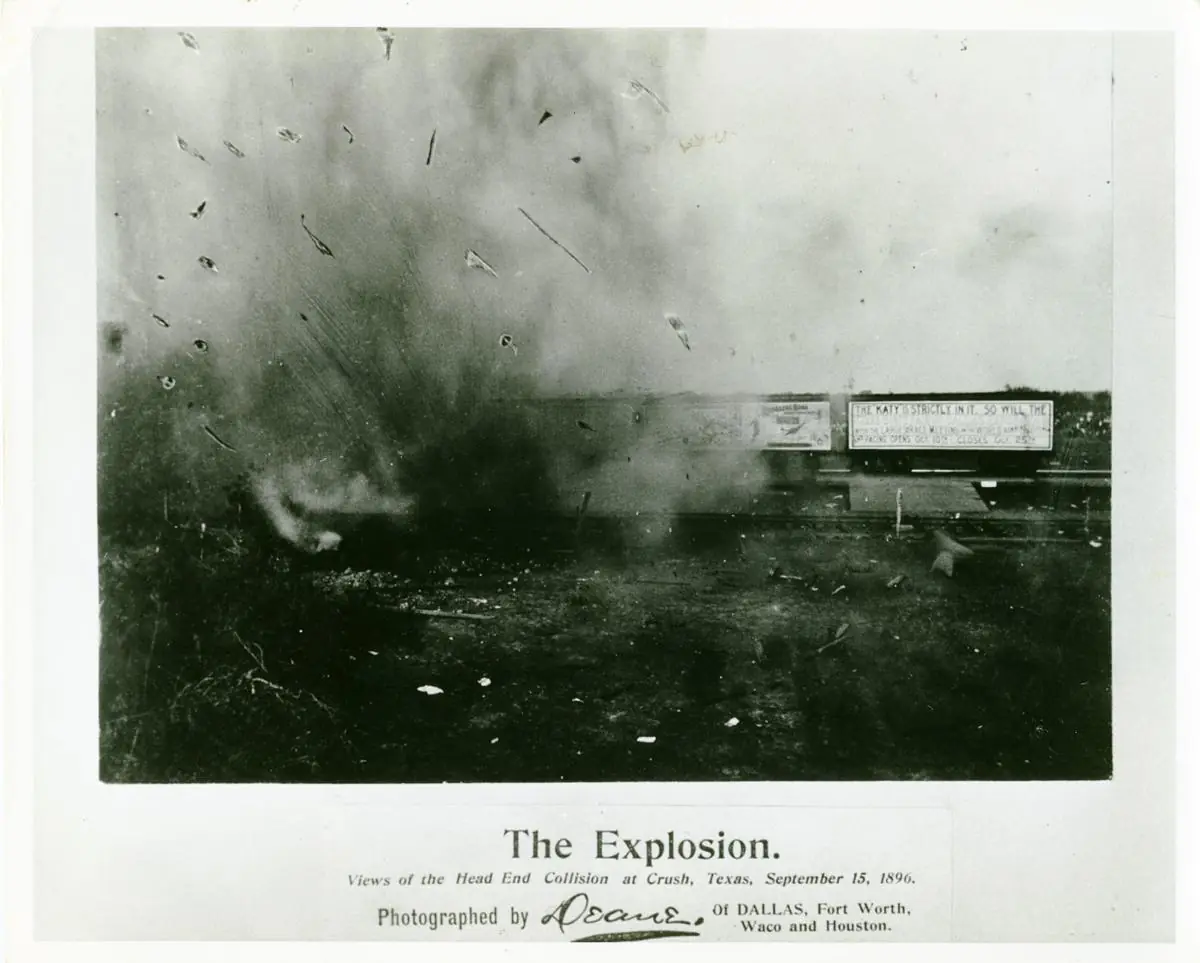
It was a little after 5 p.m. on September 15, 1896, and the Crash at Crush was seconds away. The engines hit, and a moment later both boilers blew apart. Iron rained down on the crowd. A flying bolt tore into Deane’s right eye.
Table of Contents
A Town Built for One Afternoon
The idea belonged to William George Crush, a passenger agent for the Missouri, Kansas and Texas Railroad, better known as the Katy. In 1895 he pitched his bosses a stunt: advertise a train wreck for months, sell tickets to carry spectators to the site on Katy trains, then run two old locomotives into each other. The officials agreed.
Times were hard. The Panic of 1893 had dragged a quarter of the country’s railroad companies into bankruptcy, and the Katy had old engines to spare as it replaced lighter locomotives with heavier ones. Two of the castoffs, No. 999 and No. 1001, were painted green and red and shown off in towns across Texas as rolling advertisements.
The wreck itself was free. The money was in the ride: $2 bought a round trip from any point in Texas.
In a shallow valley about 15 miles north of Waco, 500 workers laid four miles of track and built a grandstand, two telegraph offices, a restaurant set up in a circus tent borrowed from Ringling Brothers, and a midway of medicine shows and lemonade stands. A sign at the new depot told arriving passengers where they were: Crush, Texas. “Oh! but it’s going to be a smashup, though!” Crush promised the Galveston Daily News.
He wasn’t the first to try it. That May, an Ohio railroad had crashed two worn-out locomotives at Buckeye Park, a resort south of Columbus. Its general passenger agent, Engineering News reported, was “arranging for a large excursion traffic to this novel attraction.” As at Crush, the profit was in the train tickets.
The Crash at Crush, Second by Second
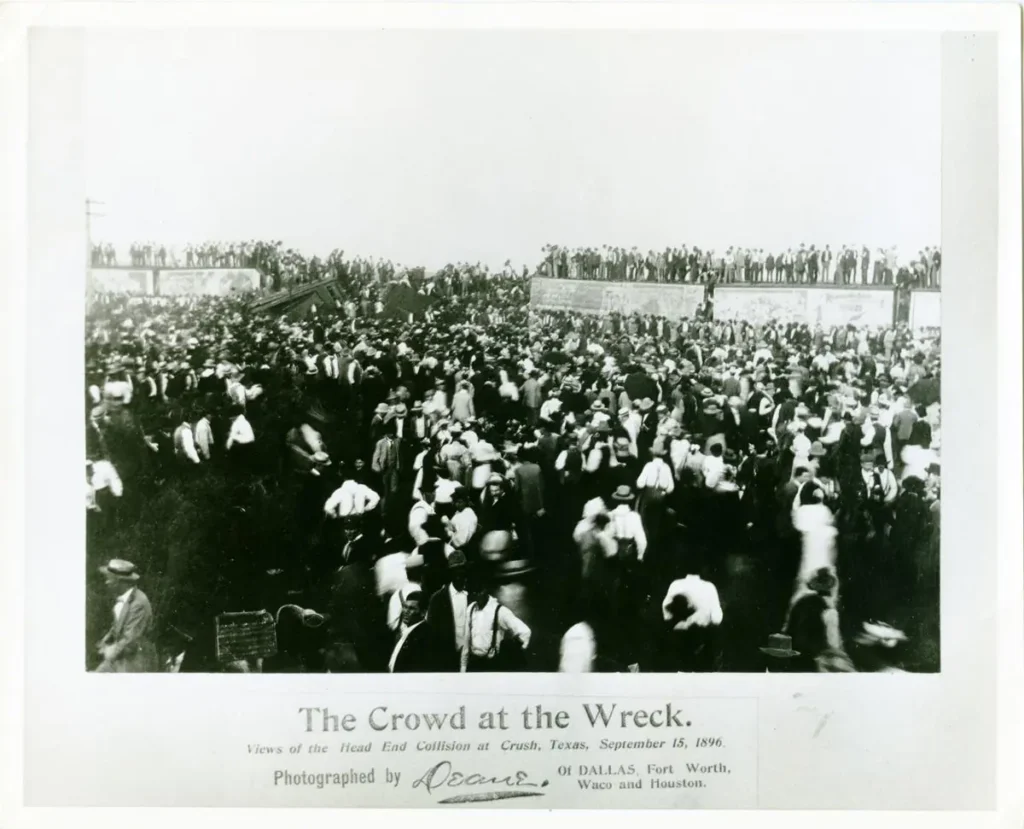
Crush expected about 20,000 people. The first of 33 packed excursion trains arrived at daybreak, and by 3 p.m. more than 40,000 were on the grounds, according to the Handbook of Texas. Some passengers had to ride on the car roofs. Estimates vary: the state historical marker says over 30,000, while one report cited by the Railroad Gazette put the crowd at 50,000.
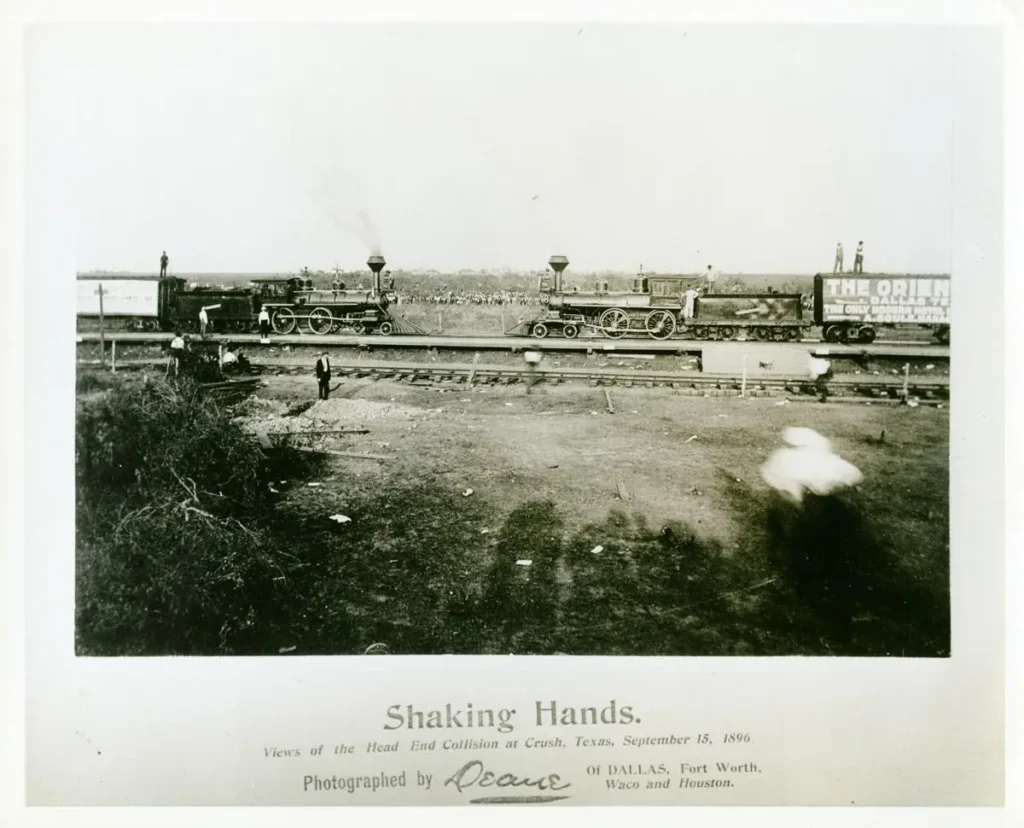
The show ran late. The crowd kept creeping toward the track and had to be pushed back. Finally the two engines rolled to the middle, touched noses for the cameras and backed away to opposite ends of the line.
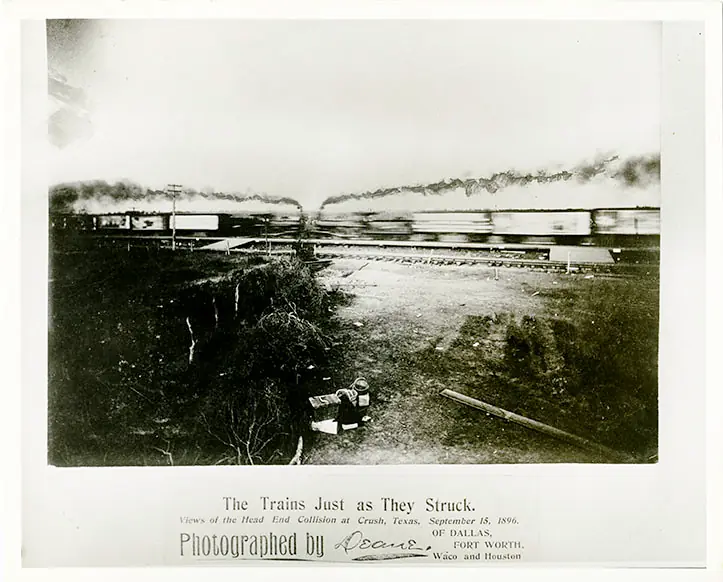
Crush rode out on horseback, raised his white hat and whipped it down. The crews opened the throttles and jumped. “We cut the reverse lever back to the second notch, stayed with the engine for 16 exhausts—that’s four turns of the drivers—and jumped,” fireman Frank Barnes recalled in the Katy’s employee magazine in 1950. “I figure they were going 50 miles an hour when they crashed.”
Warning torpedoes fastened to the rails went off like gunfire as the trains ran downhill toward each other. One reporter on the scene described what happened next: “There was just a swift instant of silence, and then, as if controlled by a single impulse, both boilers exploded simultaneously and the air was filled with flying missiles of iron and steel varying in size from a postage stamp to half a driving wheel.”
The Railroad Gazette counted nine spectators badly injured by falling wreckage, two of them fatally. A teenager, Ernest Darnall, was killed by a piece of flying chain; a farmer’s daughter hit by iron died on the ride home. HistoryNet’s account adds a man who survived the blast, only to fall between the cars of a homebound train, which is why some sources count three deaths. Deane lived, but he lost the eye. Then the crowd surged toward the smoking wreck to grab souvenirs.
What the Mechanics Got Wrong
The Katy’s master mechanic had assured everyone that the boilers would not explode at the planned speed, Trains magazine reports. According to Smithsonian, just one of the company engineers Crush consulted predicted an explosion, and his warning was brushed aside. The historical marker in West, Texas, still says it plainly: the boilers exploded “contrary to mechanics’ predictions.”
Their confidence had a basis. In head-on wrecks, the two engines usually reared up into an inverted V, and the cars behind them crumpled. That is exactly what happened in Ohio four months earlier: “The engines reared up, forming an inverted V,” Engineering News reported.
But the Ohio organizers had hedged their bet. “The boiler pressure was low at the time of the collision, so as to reduce the danger to the spectators,” the journal noted, and flying metal still broke one onlooker’s leg. Back in May, it had wondered in print what would protect the crowd “in case of the possibility of a boiler explosion.”
At Crush, the engines did not rear up. They telescoped into each other and flattened. The Dallas Morning News, according to its own archives, reported the next day that precautions had been taken with the boilers. They exploded anyway.
To boiler inspectors, a working boiler has the explosive potential of a bomb. The water inside is far hotter than 212 degrees Fahrenheit; only pressure keeps it liquid. Split the shell and the pressure collapses. Part of the water instantly flashes into steam, which needs roughly 1,600 times as much room as the water it came from.
The National Board of Boiler and Pressure Vessel Inspectors calculates that even a 30-gallon home water heater failing at 90 psi holds enough energy to launch a 2,500-pound car nearly 125 feet into the air. A locomotive boiler is a far bigger vessel.
Even the crews couldn’t say exactly what failed. “I still don’t know what made those boilers explode,” Barnes said 54 years later. Still, a collision that crushed the engines together instead of lifting them would fit what the crowd saw: two boilers bursting at the same instant.
Fired That Evening, Rehired the Next Day
The Katy fired Crush that evening. The next day, it hired him back, and he stayed with the railroad until he retired in 1940, according to HistoryNet.
Part of the reason was how little the public complained. Outrage stayed mild, and the Crash at Crush made headlines far beyond Texas. The railroad settled damage claims quickly with cash and lifetime rail passes. Deane reportedly received $10,000 and a pass of his own.
Not everyone was charmed. The Railroad Gazette, a national trade weekly, observed that “not all experimenters in this line understand the tricks” of staging such a show. The 50,000 estimate, it added, “no doubt represents an aggregate amount of enjoyment so great as to make the matter of a few fatal accidents seem like a mere trifle.”
Texas merchants borrowed the buzz anyway. A Galveston clothier advertised his own “Head End Collision,” announcing that “hard times have wrecked high prices.”
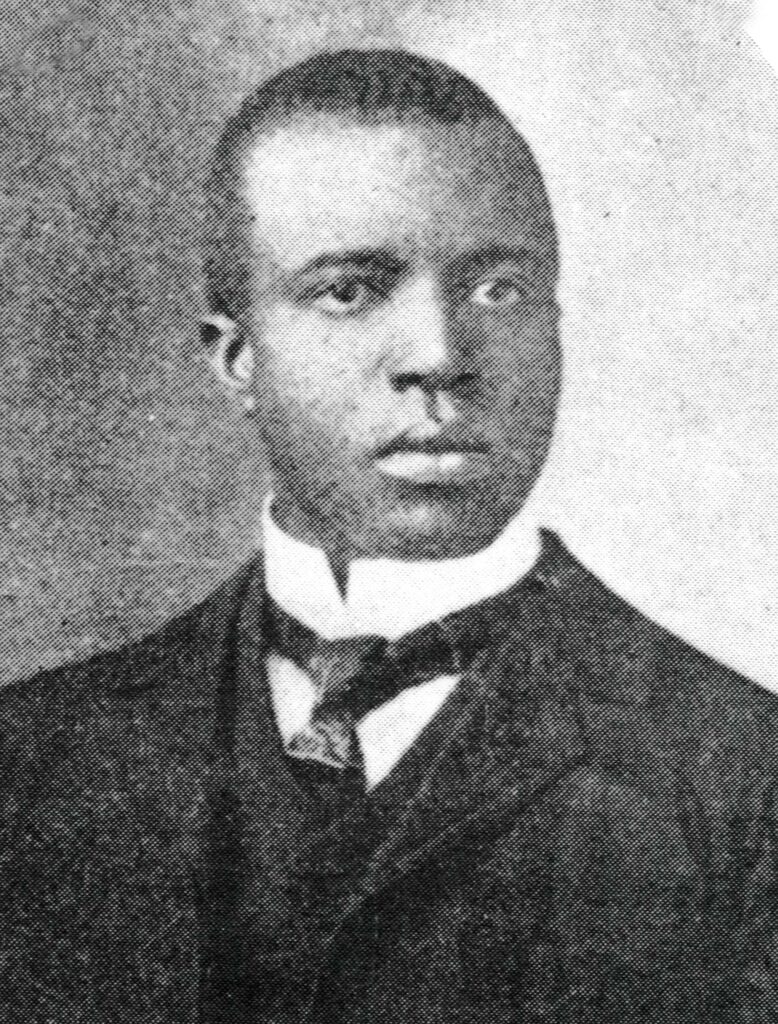
A touring musician named Scott Joplin, later famous for the “Maple Leaf Rag,” published the “Great Crush Collision March” in Temple, Texas, dedicated to the “M.K.&T. Ry.” It was among his first piano publications. The score tells the pianist when the trains are “Whistling for the crossing” and when to sound the “Whistle before the collision.” Whether Joplin saw the wreck himself is unknown.
The Man Who Wrecked 146 Locomotives
Crush never staged another wreck, but plenty of others did. Six days before the Crash at Crush, a promoter named Joe Connolly had put on his first collision in Des Moines, Iowa, for the state fair crowds. By late September, the Railroad Gazette was calling show collisions of locomotives “commonplace out West.”
Connolly, known as “Head-On Joe,” turned it into a career: 73 wrecks and 146 destroyed locomotives, ending with a 1932 show in Des Moines where the cars were labeled “Hoover” and “Roosevelt.” He claimed he never had anyone injured. He explained the appeal to Railroad Stories magazine in 1933: “somewhere in the makeup of every normal person there lurks the suppressed desire to smash things up.”
The Great Depression ended the fad. Smashing usable locomotives for fun started to look wasteful, and the last staged public wreck came in 1935. In August 2026, Guinness World Records spotlighted Connolly as the man who still holds its record for most trains wrecked.
The Last Word
Crush, Texas, didn’t last nearly as long. Souvenir hunters picked the wreck clean, the tents and stands came down, and by nightfall the town had ceased to exist. Centralia, Pennsylvania emptied out slowly over years of underground fire; Crush managed it in a single evening.
The last word goes to Jervis Deane. Not long after the wreck, he placed a notice in the newspaper: “Having gotten all the loose screws and other hardware out of my head, am now ready for all photographic business.” Nearly everyone at Crush found a way to sell that wreck, including the man it cost an eye.
Sources
- The Crash at Crush, marker 5315
- Crash at Crush
- Crash at Crush Waco History (Baylor University)
- The Railroad Gazette, Sept. 25, 1896, p. 673
- Engineering News, June 4, 1896: the Buckeye Park collision
- Retired Katy Engineer Tells of Wreck at Crush (Katy Employes’ Magazine, 1950)
- A Train Company Crashed Two Trains
- Crush’s Locomotive Crash Was a Monster Smash
- A Boiler: The Explosive Potential of a Bomb
- Wrecking Trains for Fun and Profit: Head-On Joe Connolly